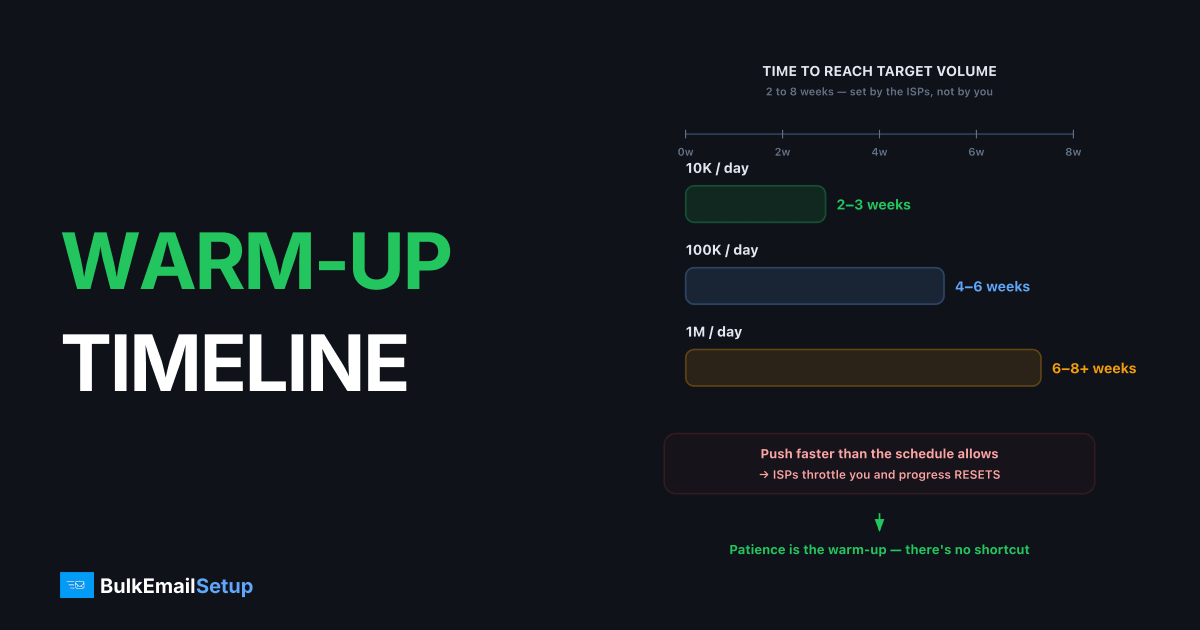
IP warm-up takes 2 to 8 weeks for most senders: roughly 2-3 weeks to reach 10,000 emails per day, 4-6 weeks for 100,000 per day, and 6-8+ weeks for 1 million per day. The timeline is set by how fast mailbox providers will extend trust to a new IP, not by how fast you can ramp, and pushing harder than the schedule allows resets your progress.
Why warm-up takes weeks, not days
A brand-new dedicated IP has no sending history. Gmail, Microsoft, and Yahoo score it as unknown, which in practice means "suspicious until proven otherwise."
Each provider watches early sends for bounces, spam complaints, and engagement. Trust accumulates per provider, per day, there is no shortcut that skips the observation window.
Realistic timelines by target volume
| Target daily volume | Typical warm-up duration | Day 1 volume | Ramp rate |
|---|---|---|---|
| 5,000/day | 10-14 days | 50-100 | ~1.5x every 2 days |
| 10,000/day | 2-3 weeks | 50-100 | ~2x every 2-3 days |
| 50,000/day | 3-5 weeks | 100-200 | ~2x every 2-3 days |
| 100,000/day | 4-6 weeks | 100-200 | ~1.5-2x every 2-3 days |
| 500,000/day | 5-7 weeks | 200-500 | ~1.5x every 2-3 days, slower past 100K |
| 1,000,000+/day | 6-8+ weeks | 500 | ~1.3-1.5x every 2-3 days past 250K |
Two patterns hold across all tiers. Early doubling is safe because absolute numbers are small; past roughly 50,000-100,000 per day, ramp increments must shrink because each step adds tens of thousands of new messages.
For a full day-by-day plan you can copy, see our IP warm-up schedule.
Per-provider differences
| Provider | Behavior during warm-up | Practical effect |
|---|---|---|
| Gmail | Engagement-weighted; tolerant of clean ramps | Fastest to trust a good sender, fastest to bulk-folder a bad one |
| Microsoft (Outlook/Hotmail) | Conservative; throttles new IPs with 4xx deferrals | Often the slowest, add 1-2 weeks for Microsoft-heavy lists |
| Yahoo | Complaint-sensitive | One complaint spike early can stall the ramp for days |
| Apple iCloud | Strict early filtering | Keep iCloud volume low for the first 2 weeks |
If 40%+ of your list is Microsoft domains, budget the long end of every range above.
What makes warm-up take longer
- Bounce rate above 2%, providers read this as a purchased or stale list. Hold volume flat until you fix it (see how to reduce bounce rate).
- Complaint rate above 0.1%, at 0.3% Gmail starts bulk-foldering everything. Stalls the ramp immediately.
- Inconsistent sending, skipping 3-4 days mid-warm-up loses momentum; providers reward steady daily volume.
- Cold or unengaged recipients early, the first two weeks should go to your most active openers only.
- Missing authentication. SPF, DKIM, and DMARC must be live before day one. Setup guide: SPF, DKIM, DMARC.
When to slow down vs. push forward
Hold volume flat for 2-3 days if any of these appear: bounce rate over 2%, complaint rate over 0.1%, Gmail Postmaster IP reputation dropping to Low, or sustained 4xx deferrals from Microsoft.
Resume the ramp once metrics stay clean for two consecutive sends. A 3-day hold mid-schedule costs far less than a block, which can set you back 2-4 weeks.
Domain warm-up runs in parallel
Warming the IP is only half the job, your sending domain builds its own reputation on the same timeline. If you are launching a new domain and a new IP together, the longer of the two clocks applies. The differences are covered in domain warm-up vs IP warm-up.
How BulkEmailSetup helps
Every dedicated SMTP server we provision ships with a managed IP warm-up: we set the daily caps, watch bounce and complaint feedback per provider, and adjust the ramp so you never trip a throttle. You send; we handle the schedule. See plans and pricing.
Frequently asked questions
How long does IP warm-up take for 100,000 emails per day?
Plan for 4 to 6 weeks. You start around 50-200 emails on day one and roughly double volume every 2-3 days, holding steady whenever bounce or complaint metrics spike.
Can I warm up an IP in one week?
Only if your target volume is very low, under 5,000 emails per day, and your list is highly engaged. For anything higher, a one-week warm-up will trigger throttling and spam-folder placement at Gmail and Microsoft.
What happens if I skip IP warm-up entirely?
Mailbox providers treat sudden volume from a cold IP as a spam signature. Expect deferrals (4xx errors), bulk-folder placement, and in bad cases an IP block that takes weeks to recover from.
Does IP warm-up start over if I stop sending?
Reputation decays after roughly 30 days of silence. A pause of 1-2 weeks usually needs a few days of reduced volume; after 30+ days idle, treat the IP as cold and re-warm from a lower starting point.