
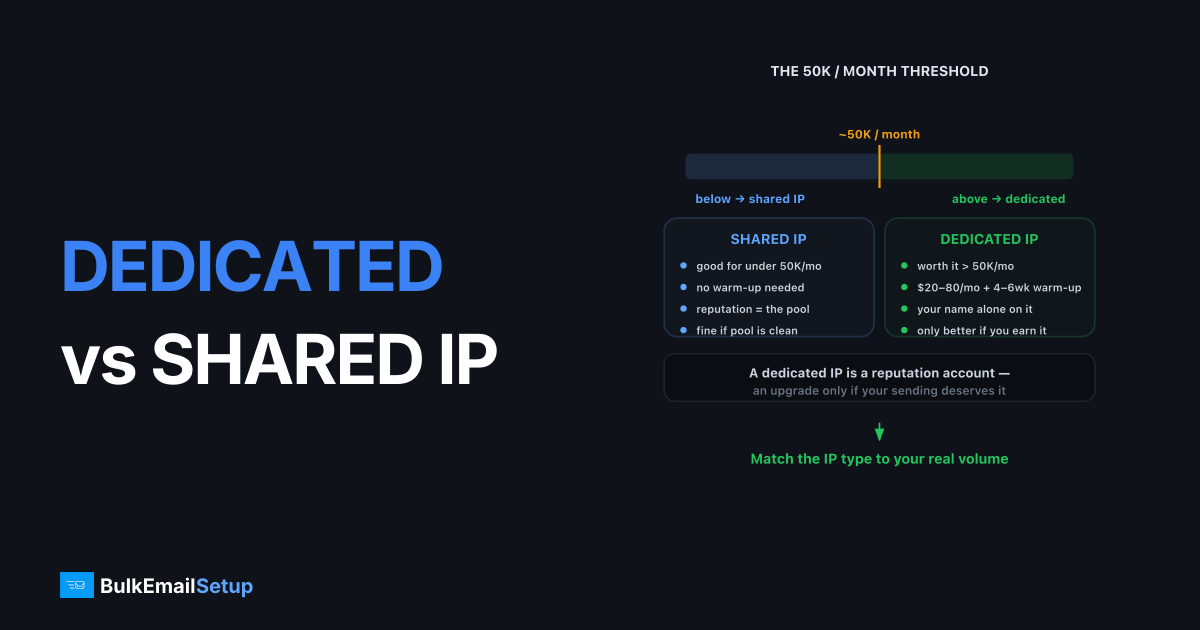
The rule of thumb: send less than ~50,000 emails a month, stay on a good shared IP pool; send more than that, consistently, every week, and a dedicated IP is worth the $20-80/month and the 4-6 week warm-up, because your deliverability stops depending on strangers. A dedicated IP is not automatically "better"; it is a reputation account with your name alone on it, which is only an upgrade if your sending practices deserve it.
The actual difference
| Factor | Shared IP | Dedicated IP |
|---|---|---|
| Reputation owner | The pool (you + strangers) | You alone |
| Warm-up needed | No, pool is warm | Yes, 4-6 weeks |
| Minimum viable volume | None | ~50K/month, sent consistently |
| Cost | Included in ESP plans | $20-80/mo (ESP) or $2-10/mo (own server) |
| Blocklist risk source | Anyone in the pool | Only your own sending |
| Diagnosing problems | Hard, is it you or the pool? | Trivial, it's always you |
| Volume spikes | Pool absorbs them | Your IP gets throttled |
Why low-volume senders should not buy a dedicated IP
Mailbox providers want to see steady history before trusting an IP. An IP that sends 5K one week, nothing the next, then 15K reads as suspicious, reputation systems treat thin, spiky data as risk.
- Below ~50K/month, your IP never accumulates enough data for a stable reputation. You get throttled like a stranger forever.
- Irregular senders (quarterly campaigns, seasonal businesses) are even worse off: reputation decays during gaps and every restart is a mini warm-up.
- A quality shared pool, policed by a good ESP, gives small senders borrowed scale: constant warm traffic, established throttling relationships, no warm-up.
The trap is cheap shared pools. Budget ESPs and "unlimited SMTP" resellers run dirty pools where spammers churn through; you inherit their blocks. Shared is only the right answer when the pool operator actively kicks abusers.
Why high-volume senders need dedicated IPs
Past ~50K/month (and certainly past 10K/day), the calculus flips:
- Control. Your complaint rate, your bounces, your blocks. When something breaks you can find it in your own logs instead of guessing about poolmates, and delisting is in your hands, not a provider queue.
- Throughput. Per-IP hourly throttles at Microsoft and Yahoo are negotiated by history. A dedicated IP with a year of clean volume gets ceilings a shared sender can't access. The per-provider numbers are in how many emails per day per IP.
- Stream isolation. Serious operations run transactional on one dedicated IP and marketing on others, so a campaign mistake never delays password resets. Same logic as subdomain separation, at the network layer.
- Accountability to providers. SNDS, feedback loops, and allowlisting programs work per-IP. A dedicated IP gives those tools a clean signal.
The cost of admission is warm-up: a new dedicated IP must ramp from ~100 emails/day to full volume over 4-6 weeks, following a plan like our IP warm-up schedule. Skip it and the IP starts life throttled and blocklisted.
Decision table
| Your situation | Recommendation |
|---|---|
| < 50K/month, any pattern | Shared (quality pool) |
| 50K-200K/month, weekly sends | 1 dedicated IP |
| 50K+/month but bursty/seasonal | Shared, or dedicated + keep-warm traffic |
| Transactional that must always inbox | Dedicated, isolated from marketing |
| 100K+/day | Dedicated pool of 4-8+ IPs, see our 100K/day guide |
| Cold outreach | Neither, mailbox-level sending or rotated dedicated IPs |
The hybrid most ESPs won't suggest
Volume-qualified senders often do best with both: dedicated IPs for the predictable base load, shared pool as overflow for spikes (Black Friday, product launches). Your dedicated reputation stays smooth and the pool absorbs the bursts, ask whether your provider supports split routing before paying for extra dedicated IPs you'll only use four days a year.
How BulkEmailSetup helps
We provision clean dedicated IPs, run the entire warm-up, and manage reputation monitoring and delisting, so you get the control of dedicated sending without the six-week babysitting project. Plans and IP counts are on our pricing page, and our dedicated IP guide covers the setup in depth.
Frequently asked questions
When should I switch to a dedicated IP?
Around 50,000+ emails per month with consistent weekly sending. Below that, a dedicated IP can't sustain enough volume to maintain its own reputation, and a quality shared pool delivers better.
Is a dedicated IP better for deliverability?
Only if you send enough volume, send consistently, and keep your metrics clean. A dedicated IP makes your reputation 100% yours, which is an advantage exactly when your practices are good and a liability when they are not.
How much does a dedicated IP cost?
ESPs typically charge $20-80/month per dedicated IP as an add-on. On your own SMTP server, additional IPs cost roughly $2-10/month each from the hosting provider.
Do dedicated IPs need warm-up?
Yes, always. A new dedicated IP has zero sending history and must be ramped over 4-6 weeks. Shared pools skip this because the pool is already warm, that is one of their genuine advantages.
Can one bad sender on a shared IP hurt my email?
Yes. On a shared IP you inherit the pool's reputation, good and bad. Quality providers police their pools aggressively; cheap ones don't, which is why shared experiences vary so widely.


