
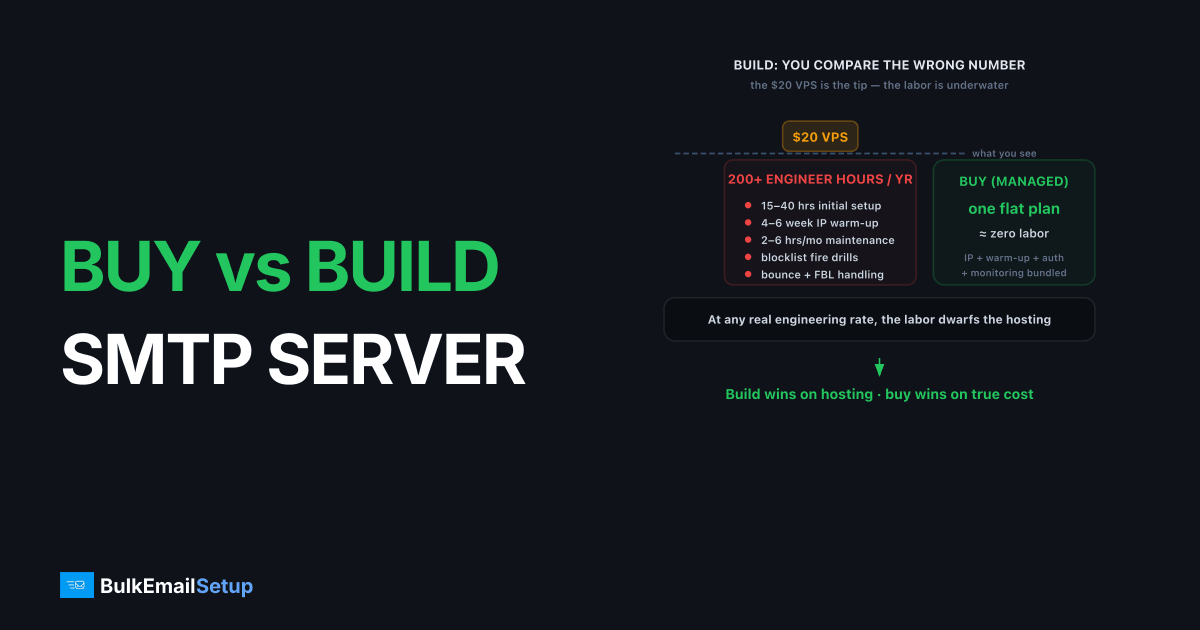
Buying a managed SMTP server is usually the lower true cost for most teams, even though building one looks cheaper on paper. A VPS running Postfix costs $10 to $40/month, but the real bill is engineering time: setup, authentication, a 4 to 6 week IP warm-up, and ongoing reputation work. Building wins on raw hosting cost. Buying wins once you price the human hours, which for most teams outweigh the server every single month.
What does building your own SMTP server actually cost?
Building costs roughly $10 to $40/month in hosting plus a large, recurring labor bill that pricing comparisons routinely ignore. The VPS is trivial. The expensive part is the engineer who configures Postfix, sets up authentication, warms the IP, and stays on call when a blocklist hits during a campaign.
Here's the realistic first-year breakdown for a self-built setup:
| Cost item | Build it yourself |
|---|---|
| VPS hosting | $10 - $40/month |
| Initial setup (Postfix, SPF, DKIM, DMARC, PTR) | 15 - 40 engineer hours |
| IP warm-up management | 4 - 6 weeks, part-time attention |
| Ongoing maintenance | 2 - 6 hours/month, patching + monitoring |
| Blocklist delisting | unpredictable, hours per incident |
| Bounce + feedback-loop handling | engineering to build or integrate |
The honest comparison isn't "$20 VPS vs $X plan." It's "$20 VPS plus 200+ engineer hours in year one vs a flat plan with zero labor." At any reasonable engineering rate, the labor dwarfs the hosting. People compare the wrong numbers and conclude building is cheap.
What does buying a managed SMTP server cost?
A managed dedicated SMTP server costs a flat monthly fee that bundles the IP, SMTP access, authentication, warm-up, and reputation monitoring into one number with no per-email meter. You trade a slightly higher line item for near-zero labor, which is where the true savings live for most teams.
The buy path removes the cost items that hurt most:
- No warm-up project. The provider ramps the IP over 4 to 6 weeks so you don't babysit a schedule.
- No delisting fire drills. Reputation monitoring and blocklist delisting are handled.
- No auth debugging. SPF, DKIM, DMARC, and PTR are configured correctly from day one.
- Predictable bill. A flat plan, not a per-send meter that spikes during launches.
We've seen teams spend their first two months self-hosting entirely on warm-up and blocklist issues instead of their actual product. The server worked in a day. Making it inbox reliably is what ate the calendar. One team we picked up had a Postfix box passing every local test, then discovered their cloud provider silently blocked outbound port 25, so mail sat in the queue with connect to ... Connection timed out and never left the host. That one line cost them a week before anyone thought to check the egress rule rather than the mail config.
When does building actually make sense?
Building makes sense when email is your product or you need deep customization, and you have in-house mail expertise to carry the ongoing load. For a team with a dedicated deliverability engineer, self-hosting gives full control over routing, queueing, and MTA choice. The labor cost is real but it's labor you already have.
For everyone else, the math favors buying. If you're choosing an MTA at all, you're already deep in the weeds: see Postfix vs Exim vs Haraka for what that decision involves. Most senders read that and decide they'd rather not own it.
A VPS to self-host SMTP costs $10 to $40/month, but the true first-year cost includes 15 to 40 hours of initial setup plus ongoing patching, monitoring, and blocklist work (industry-typical estimates, early 2026). For teams without in-house mail expertise, the labor routinely exceeds the cost of a managed dedicated SMTP plan.
Build vs buy at a glance
| Factor | Build (self-host) | Buy (managed dedicated SMTP) |
|---|---|---|
| Monthly hosting | $10 - $40 | flat plan |
| Engineering hours | high, ongoing | near zero |
| IP warm-up | you run it | done for you |
| Authentication setup | you configure | configured correctly |
| Blocklist response | you firefight | monitored + handled |
| Customization | maximum | provider-defined |
| Best for | teams with mail expertise | teams who send, not build |
If your volume already justifies dedicated infrastructure but you don't want the labor, the comparison usually ends here. For the broader trade-off across self-hosted, managed, and ESP, see our managed SMTP vs DIY time cost breakdown.
What goes wrong most often when teams build?
The most common failures when building are authentication mistakes, skipped warm-up, and a missing or wrong PTR record, each of which sends mail straight to spam or gets it rejected outright. The server runs fine; the deliverability is what breaks, and it breaks in ways that are easy to miss until volume exposes them.
The recurring build-it-yourself failure modes:
- No PTR / wrong rDNS, so receivers can't verify the IP and reject or junk the mail. See set up a PTR record.
- SPF over 10 DNS lookups, returning PermError and failing SPF entirely.
- Skipped warm-up, so the fresh IP gets throttled with 421 deferrals and listed on a blocklist like Spamhaus.
- Port 25 blocked by the cloud provider, leaving outbound mail stuck.
- No bounce or feedback-loop handling, so the list rots and complaints climb unseen.
In the self-hosted setups we've reviewed, missing or misconfigured PTR and an SPF lookup overflow are the two single most common reasons a freshly built server can't inbox. Both are invisible in a basic "did the email send" test and only surface when real receivers start rejecting. That gap between "it sent" and "it inboxed" is where most DIY projects stall.
What's the break-even point in real numbers?
The break-even is simpler than it looks once you price the labor. Take the year-one hours, multiply by a loaded engineering rate, add the VPS, and compare that total to twelve months of a flat managed plan. The hosting saving is almost never large enough to cover the hours.
Here's a worked example at a conservative $60/hour loaded rate, using the low and high ends of the build estimate:
| Line item | Low estimate | High estimate |
|---|---|---|
| VPS hosting (12 months) | $120 | $480 |
| Initial setup (15 - 40 hrs @ $60) | $900 | $2,400 |
| Warm-up attention (20 - 40 hrs @ $60) | $1,200 | $2,400 |
| Monthly maintenance (24 - 72 hrs @ $60) | $1,440 | $4,320 |
| Blocklist incidents (varies) | $0 | $600+ |
| Year-one total (build) | ~$3,660 | ~$10,200 |
Even the low column lands near $3,660 for the first year before a single blocklist incident. A flat managed plan rarely costs more than that annually, and it carries none of the labor. The math only flips toward building when your engineering time is effectively free, which it never is.
When we tally these numbers with senders, the warm-up and maintenance rows, not setup, are what surprise them most. Setup feels like the work; the recurring attention is what actually dominates the bill. Once those rows are written down at a real hourly rate, the "build is cheaper" assumption rarely survives contact with the spreadsheet.
Does buying lock you in?
Buying doesn't have to lock you in, because a dedicated SMTP server gives you standard SMTP access, the same protocol any app already speaks. You connect over host, port 587, and credentials, exactly as you would to any mail server, so your application code isn't tied to a proprietary API.
That's a real difference from some ESPs, where your integration is built around their specific API and migrating means rewriting code. With plain SMTP, switching providers later is a credential change, not a re-engineering project. You keep the portability of self-hosting without owning the box. The honest caveat: your sending reputation lives on the provider's IP, so moving still means warming a new IP wherever you go next, that part follows you regardless of who you buy from.
A quick build-vs-buy decision framework
Decide with three questions, not a gut feeling. Each one maps to a real cost you've now seen priced out: in-house expertise, customization need, and how much your engineering time is worth. Answer them honestly and the call usually makes itself.
- Do you have in-house mail expertise? If nobody on the team can read a bounce code or run a warm-up schedule, building means hiring or learning on a live IP. That's a hidden cost, lean buy.
- Do you need deep customization? If you require custom routing, queueing, or a specific MTA, building gives control buying can't. If standard SMTP delivery is all you need, buying wins.
- What's your engineering time worth right now? If your one backend engineer is your bottleneck, the 60 to 150+ first-year hours from the time-cost breakdown are the most expensive line item on this page.
| Your answers | Lean toward |
|---|---|
| No expertise, no customization need | Buy |
| Expertise, but email isn't your product | Buy |
| Expertise and deep customization need | Build |
| Email is your core product | Build |
The pattern is consistent: building pays off only when email is genuinely your product or your team already carries mail expertise as part of normal work. For everyone else, the labor and timing costs tip the true total toward buying.
How BulkEmailSetup helps
We give you the control of your own SMTP server without the build: a dedicated IP you control, full SMTP access, SPF, DKIM, DMARC, and PTR configured correctly, and warm-up plus reputation monitoring handled for you. You get the self-hosted result without the engineering project. See flat monthly plans on our pricing page.
Frequently asked questions
Is it cheaper to build my own SMTP server?
On hosting alone, yes. A VPS to run Postfix costs $10 to $40/month. But once you add the engineering hours for setup, ongoing maintenance, IP warm-up, and blocklist firefighting, the true cost of building usually exceeds a managed plan for most teams.
How long does it take to build an SMTP server?
A working Postfix install takes an experienced admin a day or two. Getting it to actually inbox at volume, with SPF, DKIM, DMARC, PTR, a warmed IP, and clean blocklist status, realistically takes 4 to 8 weeks of part-time work.
What is the hidden cost of self-hosting SMTP?
Labor. The server is cheap; the human time is not. Plan for ongoing patching, monitoring, bounce handling, feedback-loop processing, and blocklist delisting. One Spamhaus listing during a busy week can cost a day of senior engineering time.
Should a small team build or buy an SMTP server?
Most small teams should buy. Building makes sense when you have in-house mail expertise and need deep customization. If sending email is not your core product, a managed dedicated SMTP server is almost always the cheaper true cost.


